Why a Healthier Laundry Detergent Matters—and How to Make Your Own With Castile Soap

Share
When most people think about getting healthier, they think about food, exercise, sleep, hydration, and reducing stress.
Those are all important, but healthier living can also involve paying attention to the products we use throughout our homes.
Laundry detergent is a good example.
Think about how often freshly washed fabrics touch your body. You wear clothes throughout the day, sleep between sheets every night, dry yourself with towels, put on freshly washed workout clothes, and relax under blankets.
Laundry is simply part of everyday life.
At RoadToAHealthierLife.com, we believe healthier living doesn’t have to mean completely changing your lifestyle overnight. Small, practical changes can add up over time.
One of those changes can be simplifying your laundry routine.
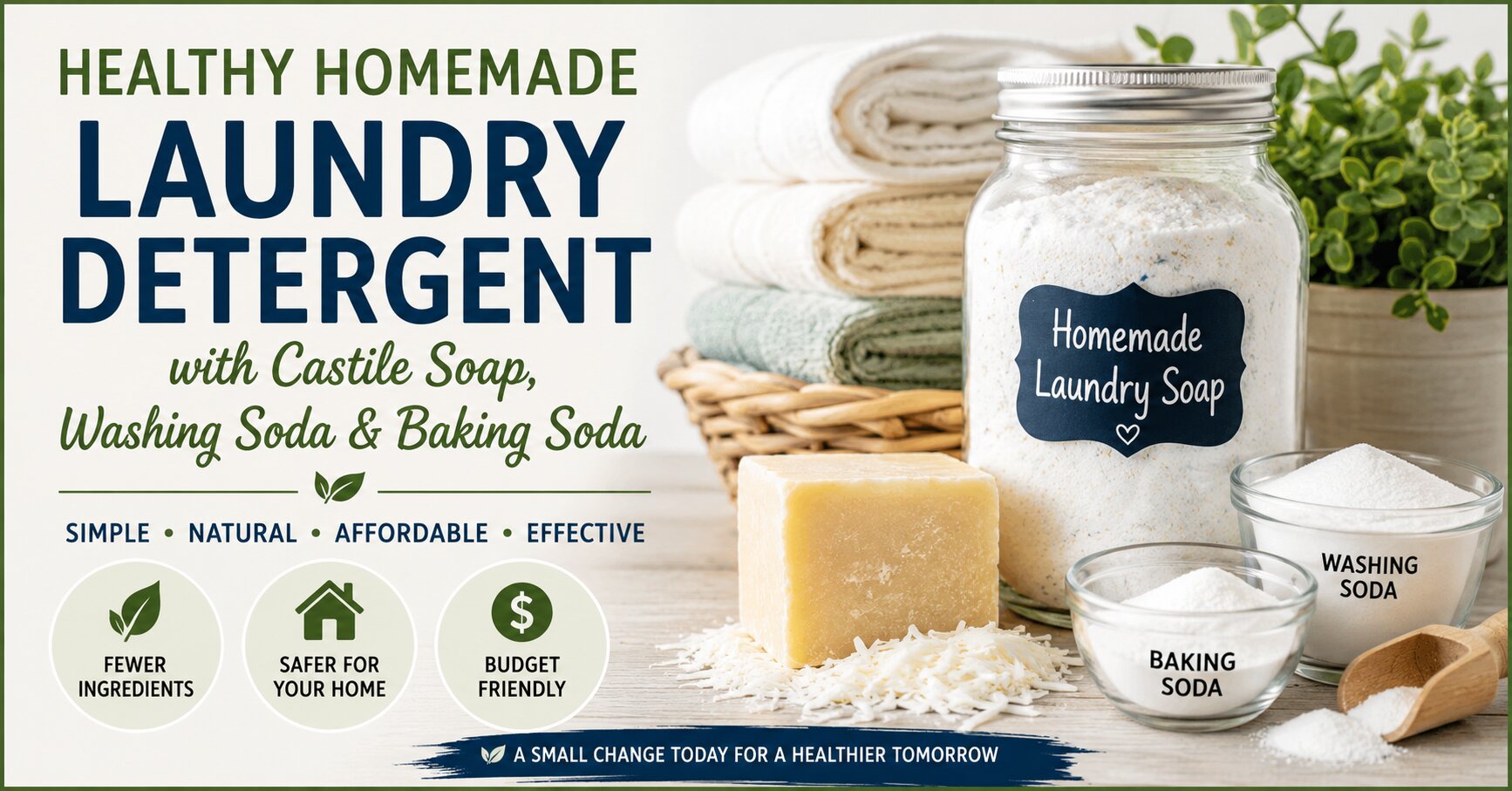
Instead of purchasing a detergent with a long ingredient list, you can make a simple homemade laundry detergent using three primary ingredients:
- Pure Castile bar soap
- Washing soda
- Baking soda
It’s inexpensive, easy to make, and lets you know exactly what you’re putting into your washing machine.
Why Think About the Detergent You Use?
Most of us have used conventional laundry detergent for years without giving it much thought.
Pour it in, start the washer, and you’re done.
Many commercial laundry products also contain fragrances, dyes, optical brighteners, preservatives, and other ingredients designed to improve scent, appearance, shelf life, or washing performance.
That doesn’t automatically make conventional laundry detergent bad.
But some households prefer a simpler approach, particularly when they want to reduce heavily fragranced products or simply use fewer household products overall.
Making your own laundry soap gives you control over the ingredients.
And you may be surprised by how little you actually need.
Your Clothes and Linens Are Against Your Skin Every Day
Consider how much time your skin spends in contact with washed fabric.
You may wear a shirt for eight or ten hours.
Your pajamas and sheets are against your body while you sleep.
You use washed towels after showering.
Then there are pillowcases, underwear, socks, workout clothes, blankets, and countless other fabrics.
That makes laundry products one area worth considering when you’re trying to simplify what you use around your home.
If you don’t particularly care for the heavy perfume associated with some laundry products, an unscented homemade formula can also leave your laundry smelling much more neutral.
Clean does not have to mean heavily perfumed.
The Benefits of Making Homemade Laundry Detergent
There are several reasons people decide to make their own laundry soap.
1. You Know What’s in Your Laundry Detergent
One of the biggest advantages is simplicity.
This homemade laundry detergent uses three primary ingredients.
Pure Castile Bar Soap
Castile soap is traditionally made using vegetable oils.
In this recipe, it provides the soap that helps loosen everyday dirt, oils, and grime from washable fabrics.
For the simplest formula, choose an unscented pure Castile bar soap.
Washing Soda
Washing soda is sodium carbonate.
Its alkalinity helps boost cleaning performance and can be particularly useful when minerals in hard water interfere with soap.
Baking Soda
Baking soda is sodium bicarbonate.
It is commonly used around the home for cleaning and deodorizing and can help with everyday laundry odors.
Combined, these ingredients create an easy powdered homemade laundry soap.
2. You Can Reduce Heavy Fragrances
For some people, the strongest difference between conventional and homemade laundry products is fragrance.
Many traditional detergents are specifically formulated to leave a noticeable scent behind.
Some people love that freshly washed fragrance.
Others don’t.
If your goal is a simpler laundry routine, using an unscented Castile soap lets you wash clothes without deliberately adding a powerful perfume.
The goal becomes simple:
Clean clothes rather than strongly scented clothes.
3. Homemade Laundry Soap Can Save Money
Specialty detergents marketed as natural, fragrance-free, eco-conscious, or minimalist can become expensive.
Making laundry detergent yourself can be surprisingly affordable because you use relatively small quantities for each load.
Washing soda and baking soda are inexpensive, and both can be useful for other household cleaning jobs as well.
That makes this recipe especially practical for families doing multiple loads of laundry every week.
4. It Can Help You Simplify Your Home
A healthier lifestyle doesn’t always require buying another product.
Sometimes the better approach is simplifying what you already use.
Many laundry rooms are filled with detergent, scent beads, fabric softener, stain remover, dryer sheets, laundry boosters, and other products.
You may not need all of them.
Try simplifying your routine and determine which products actually make a meaningful difference for your household.
The same philosophy can be applied throughout your home. Creating a clean, comfortable living environment is another aspect of healthier everyday living. GN Health discusses this idea further in its guide to creating healthier homes and workplaces through better cleaning.
At Road to a Healthier Life, we’re interested in changes that are practical enough to become habits rather than temporary lifestyle experiments.
How to Make Homemade Laundry Detergent
You don’t need to boil water or make gallons of liquid detergent.
This recipe creates a concentrated powdered homemade laundry soap that can be stored in a small airtight container.
Homemade Laundry Detergent Ingredients
You will need:
- 1 bar pure Castile soap, approximately 4–5 ounces
- 2 cups washing soda
- 1 cup baking soda
- Cheese grater or food processor
- Large mixing bowl
- Airtight storage container
- Tablespoon measuring scoop
For a fragrance-free version, use an unscented Castile soap bar.
Step 1: Finely Grate the Castile Soap
This step is more important than it might seem.
Finely grate the entire Castile soap bar using the smallest holes on your cheese grater.
The finer you grate the soap, the better.
You don’t want long curls or large chunks of soap in the finished mixture because smaller pieces disperse more readily during washing.
After grating, you can put the soap through a food processor to create an even finer texture.
Aim for something resembling small crumbs rather than large soap shavings.
Step 2: Add the Washing Soda
Put the finely grated Castile soap into your mixing bowl.
Add:
2 cups washing soda
Mix thoroughly.
Washing soda helps boost the cleaning ability of the mixture and is particularly useful when dealing with harder water.
Step 3: Add the Baking Soda
Next add:
1 cup baking soda
Mix all three ingredients thoroughly until the grated soap is distributed throughout the powder.
That’s it.
You now have homemade powdered laundry soap.
There’s no cooking required.
Step 4: Store Your Homemade Laundry Soap
Transfer the finished mixture to an airtight container.
A glass jar with a tight-fitting lid works well, although a plastic dry-storage container is fine too.
The important thing is keeping the mixture dry.
Keep a tablespoon measuring scoop with the detergent so you’re not tempted to pour in too much.
How Much Homemade Laundry Detergent Should You Use?
This is where people can easily make a mistake.
More soap does not necessarily mean cleaner clothes.
Using too much soap can actually make rinsing more difficult and may contribute to residue on clothing.
Start conservatively.
For High-Efficiency (HE) Washing Machines
Start with approximately:
1 tablespoon per normal load.
Because HE machines use considerably less water, you don’t want to overload the machine with soap.
For smaller or lightly soiled loads, you may find you need even less.
For Traditional Top-Loading Washing Machines
Start with approximately:
1–2 tablespoons per normal load.
The ideal amount will depend on your machine, load size, soil level, and water conditions.
Start with less and adjust only when necessary.
What If You Have Hard Water?
Hard water is an important consideration when using traditional soap in your laundry.
Hard water contains higher concentrations of minerals such as calcium and magnesium, which can interfere with soap performance.
Washing soda helps by interacting with some of those minerals and improving washing conditions.
If your clothes begin feeling stiff, dull, or coated, don’t automatically assume you need more detergent.
You may actually be using too much soap.
Experiment with reducing the amount and see whether your clothes rinse more cleanly.
Finding the smallest effective amount is usually preferable to continually adding more.
How to Use Homemade Laundry Detergent in an HE Washer
HE washing machines are designed to operate using less water.
That’s why you should be especially conservative with homemade laundry soap.
Use finely grated soap and begin with approximately one tablespoon.
If your HE machine has a detergent drawer intended specifically for liquid detergent, follow your washer manufacturer’s directions regarding powdered products.
The goal is for the mixture to disperse thoroughly and rinse away during the cycle.
Does Homemade Laundry Detergent Work in Cold Water?
It can, but finely grating the Castile soap becomes particularly important.
Soap dissolves more readily in warmer water than very cold water.
If you regularly wash using cold water and notice that soap particles aren’t dissolving completely, place your measured detergent into a small container and dissolve it in a little warm water first.
Then add it to the wash according to your machine’s instructions.
This extra step can help distribute the soap more evenly.
What About Stains?
Homemade laundry detergent is primarily designed for everyday washing.
Tough stains often benefit from pretreatment.
Common examples include:
- Grease
- Grass
- Blood
- Coffee
- Makeup
- Tomato sauce
- Mud
- Cooking oil
One simple approach is to slightly wet the stained fabric and gently rub some Castile bar soap into the stained area before washing.
Allow it to sit briefly and then wash normally.
Treating a stain before it goes through the washer is generally more effective than repeatedly washing a stain after it has set.
Washing Soda vs. Baking Soda: What’s the Difference?
This is an important distinction because people sometimes assume these two ingredients are interchangeable.
They aren’t.
Baking soda is sodium bicarbonate.
Washing soda is sodium carbonate.
Washing soda is considerably more alkaline, which is why it is commonly used as a laundry and household cleaning booster.
Baking soda is milder and is commonly used to help neutralize odors.
That’s why this homemade laundry detergent recipe uses both.
What Fabrics Can You Wash With Homemade Laundry Soap?
This basic formula is most appropriate for ordinary washable fabrics and household linens, such as:
- Cotton shirts
- Jeans
- Socks
- Underwear
- Towels
- Sheets
- Pillowcases
- Washcloths
- Everyday household linens
Specialty fabrics may have very different washing requirements.
Wool, silk, waterproof garments, technical athletic fabrics, and other specialty materials should be washed according to their specific care instructions.
Do You Really Need Fabric Softener?
Maybe not.
One benefit of simplifying your laundry routine is discovering which products you actually need.
Try washing your clothes with the homemade formula before automatically adding fabric softener, scent beads, boosters, and other laundry additives.
You may discover you’re perfectly happy without them.
The fewer products you need to purchase and store, the simpler your laundry routine becomes.
Easy Homemade Laundry Detergent Recipe
Here’s the entire recipe again so you can save it for later.
Ingredients
1 pure Castile soap bar
2 cups washing soda
1 cup baking soda
Directions
Finely grate the Castile soap.
Mix it thoroughly with the washing soda and baking soda.
Transfer the mixture to an airtight container and keep it dry.
How Much to Use
HE washing machine: Start with approximately 1 tablespoon per normal load.
Traditional top-loading washer: Start with approximately 1–2 tablespoons per normal load.
Adjust based on load size, soil level, your washing machine, and your water.
A Healthier Life Is Built One Habit at a Time
It’s easy to make healthy living unnecessarily complicated.
You might think you need to completely change your diet, exercise every day, eliminate every processed food, replace everything in your house, and create the perfect morning routine.
You don’t.
A healthier lifestyle can begin with much smaller decisions.
Drink more water.
Cook at home more often.
Walk outside.
Get enough sleep.
Move your body.
Eat more whole foods.
Spend time with people you care about.
And become more intentional about the products you use around your home.
Making your own laundry detergent isn’t going to transform your health overnight.
But that’s really the point.
The road to a healthier life isn’t one dramatic decision.
It’s hundreds of small decisions that gradually become habits.
Final Thoughts: Start With Something Simple
Laundry is something most of us do every week.
That makes laundry detergent one of those household products we use repeatedly without thinking much about it.
Making your own homemade laundry detergent with Castile soap, washing soda, and baking soda gives you a simple alternative.
You know exactly what’s in the container.
You can make an unscented version.
You only need a small amount for each load.
And the entire recipe takes just a few minutes to prepare.
You don’t need to overhaul your entire home this weekend.
Start with one thing.
Maybe this week, it’s your laundry detergent.
Then find another small change next week.
That’s what RoadToAHealthierLife.com is about—finding practical ways to build healthier habits and create a lifestyle you can actually maintain.
One small change at a time can put you further down the road to a healthier life.